

Migration Processes in Lithuania Influenced by the War in Ukraine and Labour Migration
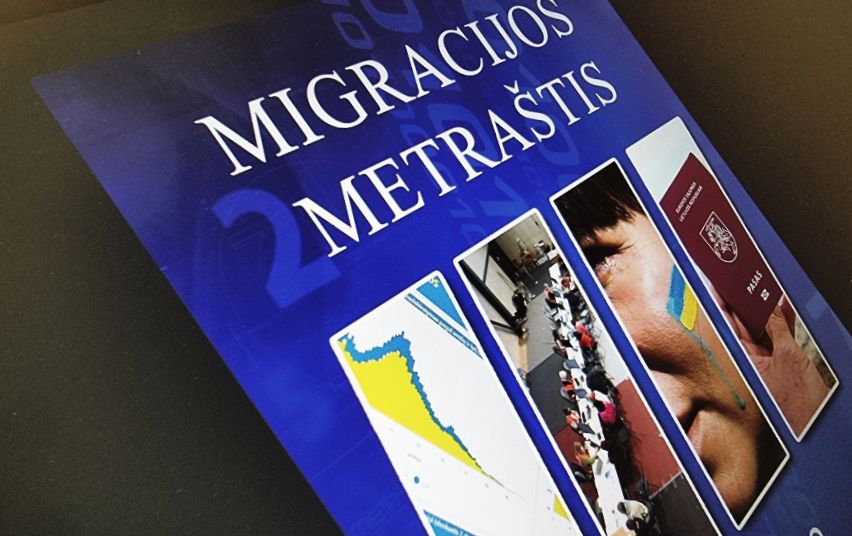
Last year, the complex geopolitical situation in the region and the continued growth of labour migration had the most significant impact on legal migration processes in Lithuania, according to the 2022 Migration Yearbook.
Two categories show particularly strong increases. The total number of foreigners living in Lithuania and the number of temporary residence permits issued reached record highs.
The nineteenth edition of the Migration Department’s e-publication traditionally provides an overview of all key statistical indicators and trends.
Last year, the number of foreigners living in Lithuania jumped by 89%. At the beginning of 2022, just over 100,000 foreigners were living in our country, and by the beginning of 2023, the figure was already over 189,000.
This is mainly due to Russia’s military invasion of Ukraine in late February 2022. This has led to a migration of people both within and from Ukraine.
Since the beginning of military action up to 1 January 2023, more than 72,000 refugees from the war in Ukraine have been registered in Lithuania, and more than 64,000 people have been granted temporary protection. The rest of the refugees fled to other European countries, returned to their homeland, or stayed in Lithuania on other grounds.
At the beginning of 2023, foreigners accounted for 6.62% of the total Lithuanian population. This is an all-time record since such data was recorded. At the beginning of last year, foreigners accounted for 3.57% of Lithuania’s total population, compared to 3.12% the previous year.
In 2022, the Migration Department issued 133,628 temporary residence permits in Lithuania. Of these, there were 117,091 first-time permits and 16,537 replacement permits.
These figures are also a record in the history of the Migration Department. In 2021, 51,821 permits were issued to foreigners (35,404 first-time permits and 16,417 replacement permits).
Last year, the largest number of temporary residence permits were issued or changed for Ukrainian citizens — 83,940 in total.
Belarusian citizens are the second-largest group in this statistical category, with 30,815 temporary residence permits issued or replaced in Lithuania in 2022. 5,042 of these documents were issued or replaced for Russian nationals last year.
In 2022, the main reason for issuing temporary residence permits to Ukrainians in Lithuania was the European Union’s Temporary Protection Mechanism for war refugees.
Meanwhile, labour migration in Lithuania has increased the number of Belarusian and Russian citizens. On this basis, more than 49,000 foreigners of various nationalities received temporary residence permits in Lithuania in 2022. The year before, there were 39,000 such foreigners.
More than 4,000 temporary residence permits have been issued or changed for foreigners working in highly skilled jobs in Lithuania. This is almost three times as many permits as the 1,428 issued the previous year.
In 2022, a total of 70,016 visas were issued to foreigners: 24,684 Schengen (type C) visas and 45,332 national (type D) visas.
This is 2,000 fewer national visas than in 2021 when 47,811 visas were issued to foreigners.
This decrease can be explained by Lithuania's decision last year to restrict their issue abroad to Russian and Belarusian citizens.
The main reasons for issuing national visas are work (18,351 visas) and long-term stay in Lithuania (15,479 visas). The latter figure has risen sharply due to the number of visas issued to Belarusian citizens on humanitarian grounds in 2022 — more than 12,000 compared to 4.7 thousand the year before.
Last year, according to the State Border Guard Service, 6,172 foreigners were denied entry to Lithuania through border control points.
Most of these people — 3,062 — had to be turned back after they were found to pose a threat to the public policy, internal security, public health, or international relations of one or more EU Member States.
A further 1,301 foreigners attempted to enter Lithuania without documents justifying the purpose and conditions of their stay, and 1,067 did not have a valid visa or residence permit.
For the full Migration Yearbook 2022, click here: https://migracija.lrv.lt/lt/statistika/migracijos-metrasciai
Last updated: 20-12-2023
Related news:
Updated List of External Service Providers: Cambodia Added
The EU Migration and Asylum Pact Enters into Force: A New Stage of Migration Management Begins
Discussion on Migration Issues Relevant to Belarusian Citizens Living in Lithuania
The Ambassador of the Kingdom of the Netherlands Visited the Migration Department