

Photos requirements
PHOTOS FOR PERSONAL DOCUMENTS REQUIREMENTS
PHOTO-QUALITY PAPER AND OTHER FEATURES
Portrait shall be printed on a high quality thin photo-paper of smooth surface.
Portrait shall not be printed on a chemically active, self-developing, sensitive to external factors (light, heat) paper.
Photo shall not have white corners, ink marks, creases, damaged emulsion layer, stains, lines, etc.
Marks or writings on the other side of the photo shall not be seen through.
GENERAL REQUIREMENTS
Portrait shall correspond to the person’s current age (it is recommended that the portrait shall be no more than 6 months old), photo shall not have creases, abrasion marks or otherwise damaged.
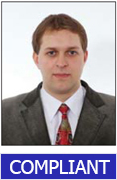 | 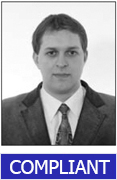 | Laser engraving produces greyscale images only, therefore in order to have a greater level of correspondence between a photo and the engraved picture it is recommended to provide a greyscale picture for ID documents that are laser-engraved (ID card, Passport, Service Passport, Alien’s Passport, Driving License, Residence Permit). |
SIZE AND EDGES OF THE PHOTO
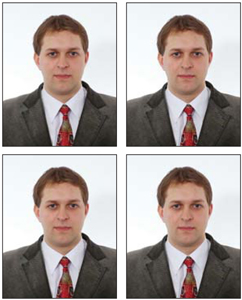
Depending on the document type, at least 3 identical photos may be required to be attached to an application. Photos must be printed on the same page.
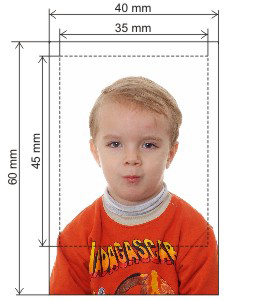
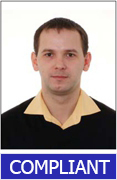
Photo size shall be 40 x 60 mm. A picture has to be taken in such a way that it would be possible to cut out 35 x 45 mm rectangles so that:
- the face from the chin to the top of the head takes up 70-80 percent of the vertical dimension;
- distance from the upper edge of the photo to the top of the head shall be 2-4 mm, distance from the top of the head to the chin shall be 31-35 mm, distance from the chin to the bottom edge shall be 8-10 mm;
- face shall be in the same distance from right-hand and left-hand edges.
 | 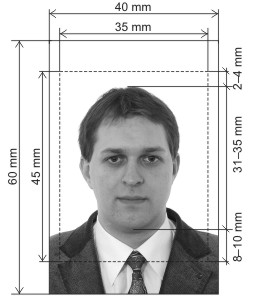 |  |
 | A picture has to be taken in such a way that it would be possible to cut out 35 x 45 mm rectangles so that: | 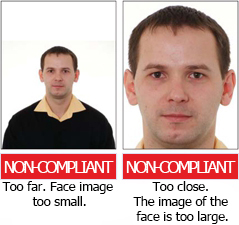 |
POSTURE
The applicant shall be sitting and looking directly at the camera: shoulders levelled, head straight, facing square to the camera.
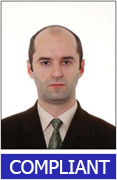 | The head shall be upright so that an imaginary horizontal line drawn between the centres of the eyes is parallel to the top edge of the picture. | 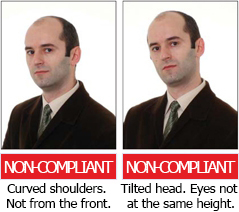 |
EXPRESSION
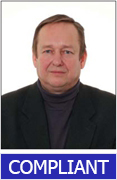 | The applicant shall be looking at the camera with neutral expression. The photo shall be rejected if the applicant displays an unnatural expression, makes faces, is laughing, mouth open, yawning or frowning. | 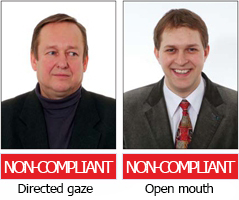 |
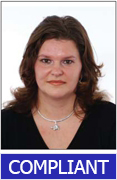 | Hair shall not obscure the face. | 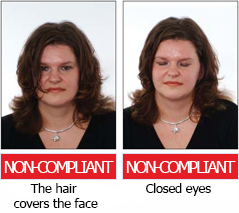 |
CLOTHING AND COVERS
Generally, the applicant must wear civil clothing, no head cover, no special uniforms.
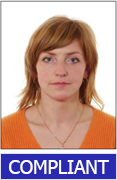 | In exceptional cases when the applicant is wearing a head cover, then the eyes, eyebrows, cheeks, chin shall be clearly visible. The applicant’s face shall not be colour-painted nor ornamented, except for the common make-up, permanent tattoos, permanent ornaments denoting a membership in an appropriate religious community or order. | 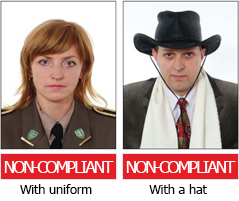 |
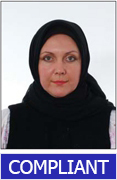 | The photo in which the applicant is shown wearing a head cover and/or special clothing shall be accompanied by a mediatory letter and shall be provided by members of religious communities or order acknowledged by the State only. However, eyes, eyebrows, cheeks, chins must still be clearly visible. | 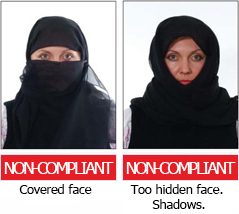 |
Applicants who wear glasses daily shall be pictured wearing them.
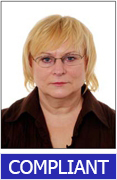 | Glasses shall not have tinted nor coloured lenses. | 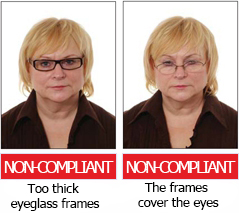 |
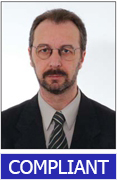 | Photo shall not display flash reflection on lenses. | 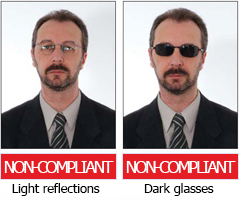 |
CHILDREN, THE SICK AND OTHER SPECIAL CASES
If a photo of a little baby cannot be taken without getting it blurry and distorted, it is permitted to have a proportionally smaller face picture, however the distance from the top of the head to the chin shall be bigger than 25 mm.
Deviations from the requirements are tolerated if the applicant is disabled and his/her natural posture or expression does not meet the general requirements.
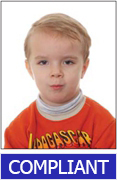 | Photo shall show the applicant alone, with no other people or items visible. | 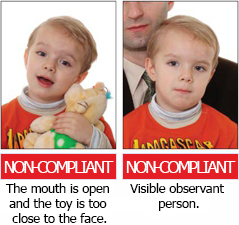 |
BACKGROUND
Background shall be such that contrast with face, hair, clothing is kept when converting the photo into greyscale.
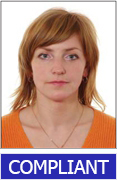 | Background must be very bright, monochrome, monotone. No shadows allowed. | 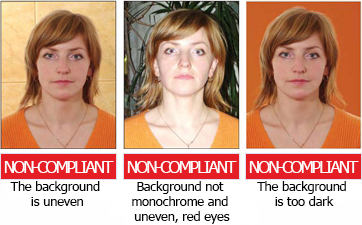 |
ILLUMINATION AND PRINTING
Illumination should not be provided by a focused intensive light of a single source. It is recommended to use a diffused light of multiple lamps or equivalent diffused illumination sources.
Photo shall be properly developed.
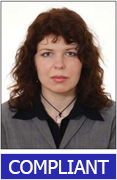 | Face shall be illuminated sufficiently and equally head-on, from the top and sides, so that there would be no shadows. | 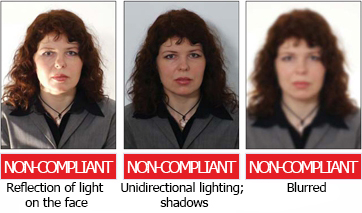 |
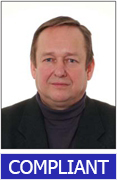 | Eyes shall not have reflections, nor red eye effect. | 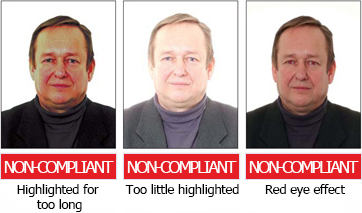 |
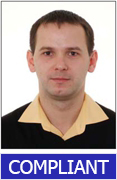 | Face shall not be retouched or tampered using software to change or delete certain facial features or hair colour. | 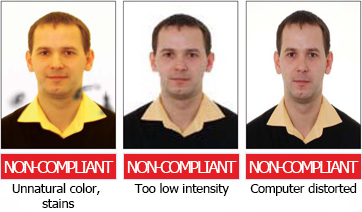 |
Last updated: 26-09-2025